.avif)
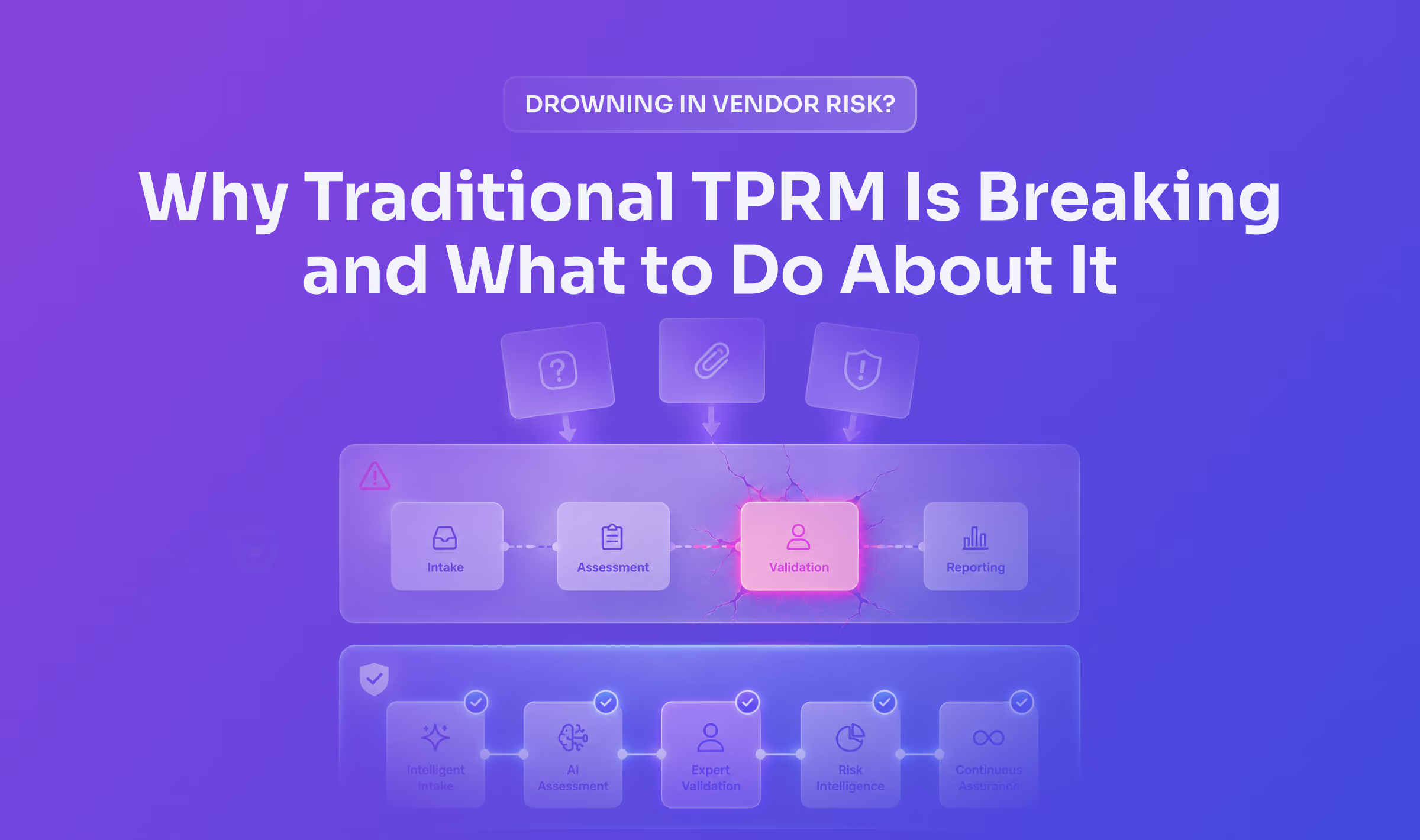
Drowning in Vendor Risk? Why Traditional TPRM Is Breaking and What to Do About It
The World Has Changed, but TPRM Has Not Kept Up
Third-party risk management is under strain in a way most organizations can no longer ignore.
What used to be a structured, periodic compliance function has quietly transformed into a continuous operational burden. As vendor ecosystems expand and businesses become more dependent on external providers, the volume of assessments has outpaced the capacity of internal teams to manage them. The result is something many leaders are now experiencing firsthand: a backlog that never seems to shrink, and a growing sense that risk is accumulating faster than it can be understood.
At the same time, expectations around third-party risk have changed dramatically. Accountability has moved to the highest levels of the organization, and the standard is no longer periodic review, but continuous oversight. It is no longer sufficient to have a process in place. Organizations are expected to demonstrate that it works, that it scales, and that it can stand up to scrutiny.
Yet most TPRM programs are still operating on a model that was designed for a different era, one with fewer vendors, slower onboarding cycles, and far less complexity.
That mismatch is where the problem begins.
Inside most organizations, TPRM still depends on a sequence of manual, time-intensive activities. Teams review documentation, analyze questionnaire responses, follow up with vendors for clarification, and interpret risk signals before making a determination. These tasks require judgment and care, which makes them difficult to scale. As the number of vendors grows, the workload increases in a predictable, linear way. The environment, however, is not growing linearly; it is expanding exponentially.
This is why backlogs form so quickly and persist so stubbornly.
New vendors are onboarded faster than they can be assessed. Questionnaires sit in queues waiting for review. Business stakeholders push for faster approvals while risk teams struggle to keep pace. Over time, what begins as operational pressure turns into something more serious. Visibility into vendor risk begins to erode. Decisions are made based on incomplete or outdated information. And the organization starts operating with blind spots it may not even be aware of.
The consequences are not confined to the security team.
Impact Blast Radius Across The Enterprise
When vendor assessments slow down, procurement cycles slow down with them. Deals can stall. Business units, under pressure to move quickly, may look for ways around formal review processes altogether, introducing an entirely new layer of unmanaged risk. What was intended to protect the organization begins to feel like an obstacle to progress.
There is also a human cost. TPRM teams often find themselves stuck in a reactive loop, focused on clearing queues rather than managing risk strategically. The work becomes repetitive and exhausting, leaving little time for higher-value activities like policy development, risk modeling, or stakeholder engagement. Burnout becomes a real concern, and turnover only deepens the capacity problem.
Most organizations respond in predictable ways. They hire more analysts, invest in new platforms, or bring in external consultants. Each of these steps can help at the margins, but none address the underlying issue.
Adding headcount increases capacity, but only temporarily, and at a cost that scales with the problem. Technology improves workflow and visibility, but it does not eliminate the need for manual analysis. Even outsourcing tends to replicate the same limitations at a higher price point, without fundamentally changing how the work gets done.
The common thread is that all of these approaches assume the same thing: that TPRM should continue to be executed primarily by internal teams, supported by tools and supplemented by external resources.
That assumption is no longer sustainable.
A New Operating Model
A different model is beginning to emerge, one that starts from a different premise entirely. Instead of trying to make internal teams more efficient at performing the same work, it rethinks where that work should live and how it should be executed.
In this model, vendor risk assessment is treated as a managed capability rather than an internal function. Automation is used to handle the high-volume, repeatable aspects of the process: reviewing documentation, mapping controls, identifying gaps, and summarizing findings. This dramatically increases throughput without sacrificing consistency.
But automation alone is not enough. The outputs must be validated by experienced practitioners who understand both the technical and business context of risk. This human layer ensures that the results are accurate, defensible, and actionable.
Finally, the entire process is delivered as a managed service. Assessments are initiated, completed, and delivered in a form that internal stakeholders can immediately use. The organization retains visibility and control, but the operational burden is removed.
This shift changes the equation in a meaningful way.
Backlogs can be eliminated because capacity is no longer tied to internal headcount. Vendor onboarding accelerates because assessments no longer sit in queues. Risk visibility improves because more of the ecosystem is consistently evaluated. And internal teams are freed to focus on higher-order priorities rather than manual execution.
More importantly, it removes the false tradeoff that has defined TPRM for years – the idea that organizations must choose between moving quickly and managing risk effectively.
The broader significance of this shift goes beyond operational efficiency. It reflects a redefinition of how organizations approach risk in an environment defined by scale, speed, and complexity. As third-party ecosystems continue to expand, the ability to assess risk at scale is no longer optional. It is a prerequisite for maintaining control.
Organizations that continue to rely on traditional models will find themselves under increasing strain, forced into difficult tradeoffs between business enablement and risk mitigation. Those that adopt a managed, hybrid approach will be better positioned to align security with the needs of the business, rather than placing them in opposition.
The conclusion is straightforward, even if the implications are significant. The challenge facing TPRM today is not a lack of effort or investment. It is a mismatch between the demands of the environment and the design of the system itself.
Addressing that mismatch requires more than incremental improvement.
It requires a change in how the work gets done.
For organizations that feel like they are drowning in vendor risk, the path forward is not to work harder within the same constraints.
It is to change the current.
Take the Next Step
If this reflects what you’re seeing in your own organization, there are a few ways to go deeper.
You can start by reading our white paper, Drowning in Vendor Risk? How to Eliminate Backlogs Without Hiring More Staff, which explores the underlying challenges and the new operating model in more detail. Download it here.
You can also watch the accompanying webinar where we walk through real-world examples and practical approaches to scaling TPRM. Watch it here.
And if you want to see what this looks like in practice, Vendict is offering a free vendor risk assessment. You can submit a vendor and receive a complete, evidence-based risk report generated through a combination of AI-driven analysis and expert validation.
No setup, no obligation – just a clear view of how to eliminate backlog and regain control of your vendor risk program. Sign up here.